
Hino vs. Isuzu Trucks: Which Is Right for Your Business?

Updated: Sep 15
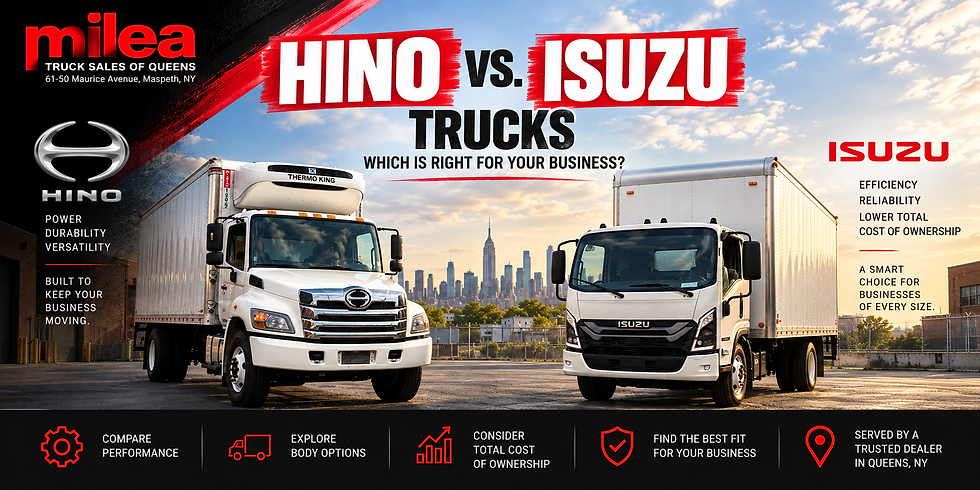
When comparing Hino vs. Isuzu trucks, the right choice depends on the work your business performs. Isuzu’s cab-over commercial trucks can be an excellent fit for urban delivery routes, while Hino’s conventional medium-duty trucks can support larger bodies and demanding vocational applications.
Businesses should compare GVWR, payload, body length, cab design, fuel type, route conditions and service needs before choosing between Hino and Isuzu.
Milea Truck Sales of Queens helps New York businesses compare Hino and Isuzu commercial trucks for delivery, refrigeration, construction, landscaping, glass transportation and other commercial applications.
What Is the Main Difference Between Hino and Isuzu Trucks?
One of the most noticeable differences between Hino and Isuzu commercial trucks is the cab design.
Isuzu N-Series trucks use a low-cab-forward design, commonly called a cab-over design. The cab is positioned above the engine, creating a shorter overall vehicle for a given body length.
Hino L Series trucks use a conventional cab design with the engine positioned in front of the driver.
The design of the cab affects maneuverability, visibility, driver experience, body capacity and the amount of space a truck requires on the road.
Neither design is automatically better. The right choice depends on where the truck will operate and what the business needs it to carry.
Quick Hino vs. Isuzu Comparison
Category | Hino | Isuzu |
Primary cab design | Conventional cab | Low-cab-forward |
Common truck series | Hino L Series | Isuzu N-Series and F-Series |
Strong use cases | Medium-duty delivery, vocational work and larger body applications | Urban delivery, local routes and maneuverable commercial applications |
City maneuverability | Depends on model and body length | Cab-over design can be well suited to tight city routes |
Body options | Dry box, refrigerated, flatbed, dump, glass and specialized bodies | Dry box, refrigerated, flatbed, dump, Switch-N-Go and specialized bodies |
Powertrain availability | Depends on the current model and production year | Gas, diesel and electric options vary by model and year |
GVWR range | Depends on model and configuration | Approximately 12,000 to 33,000 pounds across applicable models |
Best choice | Businesses needing an appropriate conventional medium-duty platform | Businesses prioritizing visibility, maneuverability and body flexibility |
Specifications and availability can change by model year. Always confirm the current truck, chassis and powertrain before making a purchasing decision.
Isuzu Commercial Trucks
Isuzu offers low-cab-forward commercial trucks designed for a wide range of business applications.
The cab-over design can provide:
Tight turning capability
Strong forward visibility
Easier urban maneuverability
Efficient use of overall vehicle length
Multiple wheelbase options
Space for a longer body on a relatively compact truck
Easier access to congested loading locations
These characteristics can make Isuzu commercial trucks particularly useful for businesses operating in Queens, Brooklyn, Manhattan, the Bronx and other densely populated areas.
Isuzu N-Series Models
Depending on model year and availability, the Isuzu N-Series may include:
Isuzu NPR
Isuzu NPR-HD
Isuzu NPR-XD
Isuzu NQR
Isuzu NRR
Isuzu NRR EV
Available GVWR ratings can range from 12,000 pounds for the NPR gas model to 19,500 pounds for the NRR. Body lengths and payload capacity depend on the cab, wheelbase, engine and completed configuration.
Isuzu N-Series trucks can support applications such as:
Dry box delivery
Refrigerated transportation
Flatbed work
Dump bodies
Landscaping
Switch-N-Go systems
Utility service
Local distribution
Specialized equipment
Isuzu Gas Trucks
Isuzu gas models may be appropriate for businesses that prefer gasoline power and operate primarily on local or regional routes.
Depending on the model, current Isuzu N-Series gas trucks may offer GVWR ratings including:
NPR: 12,000 pounds
NPR-HD: 14,500 pounds
NQR: 17,950 pounds
NRR: 19,500 pounds
Standard-cab body-length compatibility can range from approximately 10 to 24 feet, depending on the selected model and wheelbase.
Actual payload must be calculated after accounting for the truck body, equipment, fuel, driver and cargo.
Isuzu Diesel Trucks
Isuzu diesel commercial trucks are commonly used for delivery, refrigeration, construction and other demanding applications.
Depending on the current model, Isuzu diesel options may include GVWR ratings from approximately 14,500 to 19,500 pounds in the N-Series.
Diesel models can be suitable for businesses with:
Frequent commercial use
Higher annual mileage
Heavier payload requirements
Longer daily routes
Demanding operating schedules
Diesel model availability can change by production year. Contact Milea Truck Sales of Queens to verify which Isuzu diesel trucks are currently available or can be ordered.
The Isuzu NRR EV is an electric Class 5 commercial truck with a GVWR of 19,500 pounds.
According to Isuzu’s published specifications, available body lengths can range from approximately 12 to 20 feet. Battery, payload and estimated driving range vary by configuration.
The NRR EV may be worth considering for businesses with:
Predictable local routes
Stop-and-go delivery schedules
Access to vehicle charging
Trucks that return to the same facility
Fleet sustainability goals
Urban operations
Electric truck range can be affected by the completed body, cargo weight, weather, driving conditions, route and battery configuration.
Hino Commercial Trucks
Hino’s L Series uses a conventional cab design and is built for medium-duty commercial applications.
Hino L Series trucks can support applications such as:
Dry box delivery
Refrigerated transportation
Flatbed work
Tank transportation
Glass transportation
Construction
Towing and recovery
Specialized vocational work
Hino states that its L Series supports applications with GVWR ratings ranging from approximately 23,000 to 33,000 pounds, depending on the model and configuration.
Customers should confirm current model-year specifications and availability with Milea before selecting a Hino truck.
Hino L6
The Hino L6 is commonly used for medium-duty delivery and vocational applications.
Possible Hino L6 configurations include:
Dry box truck
Refrigerated truck
Flatbed truck
Tank truck
Towing or recovery truck
Specialized commercial body
A Hino L6 may be configured at a GVWR of 25,950 pounds for certain non-CDL commercial applications, provided no other licensing requirement applies.
A Hino L6 refrigerated truck can support body lengths of approximately 18 to 24 feet, depending on the chassis, wheelbase and completed configuration.
Hino L7
The Hino L7 can support heavier medium-duty applications and larger commercial bodies.
Possible configurations include:
Dry box truck
Refrigerated truck
Glass body truck
Flatbed truck
Heavy vocational body
Specialized commercial equipment
A Hino L7 may have a higher original GVWR or be derated to 25,950 pounds for certain applications. For example, a derated Hino L7 glass body truck may support a body length of approximately 22 to 26 feet.
The final GVWR, payload and body compatibility must be verified for the specific truck.
Cab-Over Versus Conventional Cab
Cab design is one of the most important considerations when comparing Hino vs. Isuzu trucks.
Potential Advantages of an Isuzu Cab-Over Truck
Tight turning capability
Strong forward visibility
Compact overall vehicle length
Easier maneuvering on narrow streets
Efficient space for the truck body
Practical for frequent city deliveries
Potential Advantages of a Hino Conventional Truck
Familiar driving position
Conventional front-engine layout
Suitable for medium-duty applications
Strong fit for larger body configurations
Useful for regional routes and vocational work
Available for specialized commercial applications
Drivers should test the seating position, visibility, cab access and turning characteristics before selecting a truck.
Which Truck Is Better for New York City?
An Isuzu cab-over truck can be a strong choice for businesses that make frequent deliveries on narrow or congested streets.
The low-cab-forward design can help with:
Tight turns
Urban parking
Loading-area access
Forward visibility
Stop-and-go routes
Maximizing body length within a compact footprint
A Hino truck can be a strong choice for businesses that need a conventional cab, larger medium-duty configuration or specialized vocational body.
The best truck for New York City depends on more than the brand. Body length, wheelbase, payload, turning radius and route conditions are equally important.
Which Truck Is Better for Delivery?
Both Hino and Isuzu trucks can be configured for delivery work.
An Isuzu N-Series dry box truck may be appropriate for:
Local delivery
Furniture delivery
Appliance delivery
Retail distribution
Packaged food
Tight urban routes
A Hino L Series dry box truck may be appropriate for:
Higher-volume delivery
Regional distribution
Larger body requirements
Heavier medium-duty applications
Longer delivery routes
The business should calculate cargo volume and payload before deciding.
Which Truck Is Better for Refrigerated Transportation?
Both Hino and Isuzu chassis can support refrigerated bodies when properly configured.
An Isuzu refrigerated truck may be useful for:
Urban food delivery
Short local routes
Frequent stops
Businesses that prioritize maneuverability
A Hino refrigerated truck may be useful for:
Larger refrigerated bodies
Regional food distribution
Higher-volume delivery
Medium-duty refrigerated applications
Refrigerated equipment adds weight to the truck. The chassis must provide sufficient capacity for the body, refrigeration unit, cargo, driver and fuel.
Which Truck Is Better for Construction or Landscaping?
The answer depends on the body and payload.
Isuzu trucks can support:
Flatbeds
Dump bodies
Landscape bodies
Switch-N-Go systems
Utility bodies
Hino trucks can support:
Larger flatbeds
Dump applications
Tank bodies
Towing equipment
Specialized vocational bodies
Businesses transporting stone, soil, machinery or other heavy materials should calculate payload carefully. A physically larger body does not mean the truck can legally carry more weight.
Hino vs. Isuzu Reliability
Reliability depends on more than the name on the truck.
Factors that influence commercial truck reliability include:
Preventive maintenance
Correct payload
Driving conditions
Driver behavior
Annual mileage
Engine and powertrain
Quality of previous repairs
Parts availability
Age and vehicle history
Correct body and chassis matching
A well-maintained truck operating within its rated capacity will generally provide better long-term service than an overloaded or poorly maintained vehicle.
When comparing Hino vs. Isuzu reliability, buyers should review the specific model, powertrain, maintenance requirements and local service support.
Hino vs. Isuzu Maintenance
Both Hino and Isuzu trucks require scheduled preventive maintenance.
Important maintenance items include:
Engine oil and filters
Fuel filters
Brakes
Tires
Cooling system
Transmission
Suspension
Steering
Emissions equipment
Liftgate
Refrigeration unit
Electrical system
Businesses should consider where parts and service will be available before purchasing a commercial truck.
Milea provides access to commercial truck parts, maintenance and repair support in Queens.
Hino vs. Isuzu Body Options
Both brands can support multiple commercial truck bodies when the chassis specifications are compatible.
Business application | Hino option | Isuzu option |
Local delivery | L Series dry box | N-Series dry box |
Refrigerated delivery | L6 or L7 refrigerated body | N-Series or F-Series refrigerated body |
Flatbed work | L6 or L7 flatbed | NPR, NQR or NRR flatbed |
Landscaping | Flatbed or dump configuration | Dump, flatbed or Switch-N-Go |
Glass transportation | L7 glass body | Compatible specialized configuration |
Electric delivery | Current Hino electric availability varies | NRR EV |
Heavy regional delivery | L Series or applicable heavier model | F-Series |
Specialized vocational work | L Series custom configuration | N-Series or F-Series custom configuration |
Availability and compatibility must be confirmed for each chassis and completed vehicle.
New Versus Used Hino and Isuzu Trucks
Businesses can consider both new and used Hino and Isuzu commercial trucks.
A New Truck May Be Appropriate If:
Manufacturer warranty coverage is important
The business needs a specific configuration
The truck will be used heavily
Current safety technology is a priority
The company plans to keep the vehicle long-term
A Used Truck May Be Appropriate If:
Lower initial cost is important
The business needs a truck quickly
A suitable completed body is available
The vehicle has a strong service history
The truck passes a professional inspection
Used-truck buyers should inspect the engine, transmission, frame, brakes, tires, suspension, truck body and equipment.
Questions to Ask Before Choosing Hino or Isuzu
Before purchasing either brand, ask:
What will the truck carry?
What is the expected payload?
What body type is required?
What body length is needed?
Where will the truck operate?
Will the driver need a CDL?
Is gas, diesel or electric the better fit?
Does the business need a liftgate?
How many miles will the truck travel?
Is local parts and service support available?
Is the truck currently available?
What warranty coverage applies?
Can the chassis support all required equipment?
Frequently Asked Questions
Is Hino or Isuzu better?
Neither brand is automatically better for every business. Isuzu may be a stronger fit for businesses prioritizing cab-over maneuverability and urban operation. Hino may be a stronger fit for businesses that prefer a conventional cab and medium-duty vocational platform.
Is Hino or Isuzu better for New York City?
Isuzu’s cab-over design can be well suited to congested city routes because of its visibility and compact footprint. However, the correct choice also depends on body length, payload, route and application.
Does Milea sell Hino and Isuzu trucks?
Milea Truck Sales of Queens offers Hino and Isuzu commercial truck solutions. Current inventory, powertrains and model availability can change.
What Isuzu models are available?
Depending on the model year, available Isuzu trucks may include the NPR, NPR-HD, NPR-XD, NQR, NRR, NRR EV, FTR and FVR. Contact Milea to confirm current availability.
What Hino models are available?
Hino commercial truck options may include L Series models such as the Hino L6 and Hino L7. Contact Milea to confirm current inventory and production availability.
Are Hino and Isuzu trucks available in non-CDL configurations?
Certain Hino and Isuzu trucks can be configured at or below a 25,950-pound GVWR. Other vehicle and operating factors may still require a CDL, so businesses should verify applicable regulations.
Can Hino and Isuzu trucks use different commercial bodies?
Yes. Compatible chassis can support dry boxes, refrigerated bodies, flatbeds, dump bodies, glass bodies and specialized commercial equipment. Compatibility depends on GVWR, wheelbase, payload and body dimensions.
Does Milea offer Hino and Isuzu parts and service?
Milea provides commercial truck parts, maintenance and repair support in Queens. Contact the appropriate department to confirm service or parts availability for a specific truck.
Compare Hino and Isuzu Trucks in Queens
The best way to choose between Hino and Isuzu is to compare the trucks according to your actual business requirements.
Milea Truck Sales of Queens can help you evaluate:
Body type
Body length
GVWR
Payload
Cab design
Powertrain
Route conditions
Equipment
New and used inventory
Financing options
Milea Truck Sales of Queens61-50 Maurice Avenue
Maspeth, NY 11378(718) 396-0800
Contact Milea today to compare available Hino and Isuzu commercial trucks for your business.

Comments